I was reminded that today is Total Defence Day by the Prime Minister's Facebook post:
With the choice of MacDonald House as the focus of the photo, I guess the PM wanted to use the recent diplomatic spat with Indonesia to remind Singaporeans of the importance of national defence.
What the PM appears to have ignored is the fact that due to the government's bad economic policies of the last 2 decades, Singaporeans' economic position have been weakened considerably. The reckless importation of middle-class foreigners have pushed up asset prices while the unmitigated reliance on low-end foreign workers have suppressed the wages of lower-income Singaporeans. As such, due to these policies, the economic resilience of Singaporeans have been very much weakened.
Related to the above is the negative psychological impact on Singaporeans of feeling that we are 2nd class in our own country. As a foreign friend of mine who had recently left Singapore told me - "I came to Singapore because your government treated me better than citizens". So here, the psychological defence of Singaporeans has been seriously undermined by the government's single-minded pursuit of GDP growth.
With so many foreigners in our midst, and many of them carrying the 'I am here because I am a talent and better than you locals" attitude, our social fabric has been damaged by the increasing conflict between natives and aliens. As such, on the social defence front, we have also regressed.
In conclusion, if the government wants to move beyond rhetoric in the area of total defence, the first thing to do is to change its economic policies and take measures to heal the damage done to the aforementioned 3 pillars of total defence.
Hopefully, Total Defence Day 2015 can be a happier one for Singaporeans. 希望新加坡人不用再面對外人喧賓奪主的情況。
Saturday, February 15, 2014
Thursday, February 6, 2014
Naming a Ship After Criminals
As we learnt today, the Singapore government has protested against Indonesia's decision to name a navy ship in honour of 2 soldiers who carried out the bombing of MacDonald House in 1965. While that's the right thing for the government to do, and many Singaporeans are understandably unhappy about the incident, the fact of the matter is that we can do nothing about it. We are a tiny red dot and Indonesia is a very big country.
Immediately after reading this piece of news, I was reminded of how some liberal-minded Singaporeans were calling for the removal of compulsory national service many years ago when I was still in university. The premise of that call was that we have excellent relations with our neighbouring countries, and thus we don't need a large standing army to defend ourselves against them. Unfortunately, over the years, more Singaporeans have come to subscribe to this flawed understanding of reality, including some opposition politicians hoping to score points against the PAP.
To me, this episode is just another reminder of a fundamental geopolitical fact: When you are a small country, you WILL be bullied. This means not only that we have to have a strong military as a means of deterrence, but also that we just have to be street-smart enough to deal with this reality, and at times, even to turn this weakness into an advantage. Protesting verbally is only 'for show', to maintain our 'face' and a modicum of respectability. If we want to get back at Indonesia, we have to think of something else. All is fair in foreign policy.
All I hope for now is that there are enough cunning and savvy people running our national strategy and foreign policy. At present, I'm not too hopeful.
Immediately after reading this piece of news, I was reminded of how some liberal-minded Singaporeans were calling for the removal of compulsory national service many years ago when I was still in university. The premise of that call was that we have excellent relations with our neighbouring countries, and thus we don't need a large standing army to defend ourselves against them. Unfortunately, over the years, more Singaporeans have come to subscribe to this flawed understanding of reality, including some opposition politicians hoping to score points against the PAP.
To me, this episode is just another reminder of a fundamental geopolitical fact: When you are a small country, you WILL be bullied. This means not only that we have to have a strong military as a means of deterrence, but also that we just have to be street-smart enough to deal with this reality, and at times, even to turn this weakness into an advantage. Protesting verbally is only 'for show', to maintain our 'face' and a modicum of respectability. If we want to get back at Indonesia, we have to think of something else. All is fair in foreign policy.
All I hope for now is that there are enough cunning and savvy people running our national strategy and foreign policy. At present, I'm not too hopeful.
Saturday, December 14, 2013
My Thoughts Regarding The Recent Riot
I think that the recent riot in the Little India area is yet another piece of evidence that the government is losing its ability to manage the basics of the country effectively. Happening not long after the spate of vandalism acts against various government websites, I feel that the effects of years of neglecting the basics has now become more visible, and are likely to get worse.
Looking at the government's reaction to the riot, I think that it is still not able to fully appreciate the severity of the crisis that we are in. By stressing that it was an isolated incident, I feel that the Cabinet is still unwilling to take a fundamental reappraisal of its economic strategy, and will continue to pursue a fairly aggressive immigration policy in the pursuit of further economic growth.
To me, the riot ought to be a very loud and clear wake-up call that we need to re-look at how the country is being run. Unfortunately, I think the lesson will be lost and that there may have to be more serious issues erupting to the surface before both the people and the government become fully aware of the depths of the crisis that we are in.
Looking at the government's reaction to the riot, I think that it is still not able to fully appreciate the severity of the crisis that we are in. By stressing that it was an isolated incident, I feel that the Cabinet is still unwilling to take a fundamental reappraisal of its economic strategy, and will continue to pursue a fairly aggressive immigration policy in the pursuit of further economic growth.
To me, the riot ought to be a very loud and clear wake-up call that we need to re-look at how the country is being run. Unfortunately, I think the lesson will be lost and that there may have to be more serious issues erupting to the surface before both the people and the government become fully aware of the depths of the crisis that we are in.
Friday, August 30, 2013
Private Property Market Up 20% in Next 3 Years?
Just came across a new piece reporting that real estate industry analysts publicly suggesting that despite the government's cooling measures, land prices in the private property market could go up by 20% in the next 3 years, with finished products going up between 10-15% in prices. The crux of the argument is that Singapore's population will continue to increase. In recent weeks, I have heard this bullish argument repeatedly from various quarters. How strange, I thought, that people have such short memory about the public outcry against the Population White Paper published earlier this year. I am not sure if the government can 'pull a fast one' on Singaporeans in this matter, although I would certainly be disappointed in our democracy if we can be so easily hoodwinked.
In any case, when it comes to the state of the real estate market, I don't trust the analysis of those within the industry. They often appear to me to be no more than advertorial writers 'preaching the party line' with constantly bullish views.
Economically, I see a lot of issues in the next 2-3 years globally. I doubt Singapore can escape unscathed. In fact, the initial salvos of the next crisis may already be upon us, with the weakening of the ASEAN economies in recent months.
In any case, when it comes to the state of the real estate market, I don't trust the analysis of those within the industry. They often appear to me to be no more than advertorial writers 'preaching the party line' with constantly bullish views.
Economically, I see a lot of issues in the next 2-3 years globally. I doubt Singapore can escape unscathed. In fact, the initial salvos of the next crisis may already be upon us, with the weakening of the ASEAN economies in recent months.
Thursday, January 31, 2013
On the Growth Imperative of the Population White Paper
Having completed the reading of the White Paper, I will now look at the underlying logic of the argument that Singapore needs a much larger population to sustain ourselves economically. This logic I will term as the 'growth imperative'.
Why we need economic growth
A major theme in the White Paper is the need for continued economic growth. The most obvious reason for this is that we need to fund the retirement of the current generation of working Singaporeans, so as to lessen the fiscal burden of the next generation of Singaporeans.
Economic growth is needed in order to generate the investment returns needed to grow our retirement savings. This is required both at the individual and the national level. At the individual level, growth will allow our investment portfolio to increase in value over time. At the national level, growth is needed so that the government can afford to pay us the above-market interest rates for our CPF savings.
There is one other less savoury reason for the need for economic growth: debt. Singaporeans are very heavily indebted, as many of us have decided to overpay for housing and private transportation. Now before we blame the government's policies regarding this, I just want to say that even within the constraints of such policies, we have a measure of freedom of choice, and I would argue that many of us have chosen poorly. This has resulted in many of us being enslaved to our housing and car loans. If there is no economic growth, we would have a financial collapse.
Why we need economic growth
A major theme in the White Paper is the need for continued economic growth. The most obvious reason for this is that we need to fund the retirement of the current generation of working Singaporeans, so as to lessen the fiscal burden of the next generation of Singaporeans.
Economic growth is needed in order to generate the investment returns needed to grow our retirement savings. This is required both at the individual and the national level. At the individual level, growth will allow our investment portfolio to increase in value over time. At the national level, growth is needed so that the government can afford to pay us the above-market interest rates for our CPF savings.
There is one other less savoury reason for the need for economic growth: debt. Singaporeans are very heavily indebted, as many of us have decided to overpay for housing and private transportation. Now before we blame the government's policies regarding this, I just want to say that even within the constraints of such policies, we have a measure of freedom of choice, and I would argue that many of us have chosen poorly. This has resulted in many of us being enslaved to our housing and car loans. If there is no economic growth, we would have a financial collapse.
Why the need for population growth
Now, in order to achieve economic growth, the White Paper assumes the need to grow our workforce, as can be seen in paragraph 1.7. So the next obvious question to ask would be this: Why do we need more people to achieve economic growth?
We can answer this question by taking a looked at a simplified version of the standard growth accounting equation that is used in economics:
Economic growth = Growth in capital + Growth in labour + Productivity Growth
In the first decades after independence, the Singapore economy had undertaken massive investments in capital to allow us to move from a labour-intensive economy to a capital-intensive one. As argued by several US academics in the mid 90s, we have passed the point of diminishing returns in this area, and so while we will undoubtedly continue to engage in capital formation, this can no longer be the main source of our growth.
We have also tried to improve productivity for several decades with mixed results. In fact, if we could validly apply to Singapore the analysis done by Northwestern University's Prof. Robert J. Gordon on the diminished growth prospects of the U.S. economy, then it would be arguable that growth via this channel would not be easily attainable.
So this leaves us with only growth in labour as the remaining channel for growth. This factor has 2 parts: growth in the number of people in the workforce as well as growth in the number of hours worked. Since there is a natural limit in the latter, the emphasis in recent years towards increasing the former.
Problems with the logic
While I can understand the economic logic of the White Paper, there appears to me to be several problems with the ideas in the plan.
Firstly, while Chapter 2 of the White Paper talks about the need for strong families, our current economic model and its growth imperative are totally incompatible with improving family life. Making pronouncements regarding the need to 'put families first', as in paragraph 2.6, will just be empty talk unless our economic model is changed in a fundamental way. No new ideas on how family life can be enhanced have been introduced in the White Paper. So there is a major contradiction between the pillar about having a strong Singaporean core and the pillar about a dynamic economy.
Secondly, paragraph 3.18 talks about helping older people find work , but this will be futile if you also have a policy of allowing easy access to foreign labour, which we do now. There will be no economic compulsion to hire older workers. As we can tell from the incentives given by the government to employers in this area, they have not been successful in materially improving the employment chances of older people.
The 2 points aforementioned form part of the reason why I think the plan will fail to achieve its desired outcomes.
When I next have time, I will look at how increasing our population will further worsen our national vulnerability to systemic shocks and risks.
Tuesday, January 29, 2013
Initial Thoughts on the 2013 Population White Paper
The National Population and Talent Division of the Prime Minister's Office has published the much-anticipated White Paper on our population woes. Entitled "A Sustainable Population for a Dynamic Singapore", it has sketched out an upper bound population of 6.9 million inhabitants by 2030. As expected, the negative reactions came fast and furious online, with the stronger reactions calling for the PAP to be replaced in the next general elections.
The plan has three central 'pillars', namely 'Maintaining a strong Singaporean core', 'Creating good opportunities for Singaporeans', and a 'High quality living environment'.
Having read the Executive Summary so far, I would like to take a 'deconstructionist' approach and point out some of the issues I see with the plan.
The plan has three central 'pillars', namely 'Maintaining a strong Singaporean core', 'Creating good opportunities for Singaporeans', and a 'High quality living environment'.
Having read the Executive Summary so far, I would like to take a 'deconstructionist' approach and point out some of the issues I see with the plan.
With regard to the first pillar, we see this:
First, Singaporeans form the core of our society and the heart of our nation. To be a strong and cohesive society, we must have a strong Singaporean core. Strong families are the bedrock of our society, ..
The problem with this is that I have been hearing rhetoric about 'strong families' since I was a child, and what I see before my eyes is the progressive decay of our families which, given wider cultural trends, shows no signs of abatement. Apart from talking about enhancements that have already been made to the marriage and parenthood packages, I see nothing new in terms of dealing with the non-economic (cultural, religious, ethical) aspects of the decline in family life. As a student of economics, I would say that if the government cannot move beyond looking at this issue from only an economics perspective, the Singaporean core that we will have by 2030 will be a very rotten one.
As for the second pillar, I find the following passage loaded with irony:
Second, our population and workforce must support a dynamic economy that can steadily create good jobs and opportunities to meet Singaporeans’ hopes and aspirations.
The word 'hopes' was highlighted in the original document. The irony in the aforementioned is that it is precisely because Singaporeans have, as a people, lost hope in the future that we have stopped reproducing ourselves. A plan that aims to persuade us of the need for more people to be allowed to live on our very over-crowded island will do everything else but give us more hope in the future.
Besides this, given the government's economic track record for the past 10 years, where we have had to bring in more and more cheap labour to support our economy, where productivity has been in decline, where there had been a series of asset bubbles (which still persist), and where we've been asked to set aside our moral values to allow for casinos, I believe it is not unreasonable to ask about the extent to which we can be confident that the same set of ideas and paradigms will enable us to create a dynamic economy when the record has been so poor (especially with regard to income inequality).
The third pillar isn't too promising either. We see the following aspirations:
We must meet the infrastructure needs of a changing population and economy in a timely and efficient way, while preserving and enhancing a green environment, so that Singapore can be a unique, bustling ‘City in a Garden’.
Given the infrastructure troubles that we've had in recent years, it has been clear to some of us for some time now that we have a systemic issue with regard to the management of our infrastructure. To me, the problems we have experienced and will continue to experience stems from a government/GLC culture of rewarding 'thinking work' disproportionately more than 'operational work', resulting in 'keep the lights on' type of jobs being shunned and lowly regarded, often outsourced to cheaper foreigners.
Until we see a change in the work culture, not only will the aforementioned aspiration be a pipe dream, we won't even be able to keep things running properly with our current population size.
Based on the foregoing, my initial impression of the White Paper is that the plans contained therein will not be achieved unless we see radically different ideas put forth in the governance of our country.
More on this topic later after I have read more of the document.
Sunday, January 20, 2013
PRC Immigrants Complain About Noise from BE Electioneering
Some PRC immigrants living in Punggol East appear to be unhappy about the noise generated from the campaigning activities of the various political parties.
We have here an example of what economists call 'free rider' behaviour, where one wants to enjoy the benefits of the system without paying a price for those benefits.
Electioneering activities are part of the democratic process in this country. Non-citizens need to accord basic respect for the process.
Saturday, January 19, 2013
China Escalates War Talk
The war rhetoric continues
Heavier dosage for the home audience:
Sunday, December 16, 2012
Something Wrong with Our Economic Strategy?
Based on the standard model of economic development that is taught in economics courses, we know that as a country develops, it moves away from labour-intensive industries and tend to rely on increasing capital intensity and productivity improvements to boost economic growth.
While the government has been exhorting us the lumpen proletariat to improve our productivity, it has nonetheless in the last 15-20 years been preaching the need to import foreign labour in order to maintain our economic growth. As a result, productivity growth has been anemic while Singaporeans wonder about the nature of our collective identity and have to cope with stresses to our social and physical infrastructure.
Many of us feel that after this period of so-called growth, we are now worse off than before. This brings to mind a passage from written by Bill Gross, the PIMCO bond king:
We can see that a properly developed economy should have a structural reduction in the need for manpower. On the other hand, given our recent experience, the government is telling us that Singapore needs to keep importing people to sustain our economy. What these 2 things tell me is that we are probably pursuing an incorrect strategy for economic development. Instead of moving up the technological and productivity scale, we are relying on a low-tech, labour-intensive service sector to continue to power our economic growth.
What this means is that we are moving in the wrong direction as far as economic development is concerned, i.e. towards a more 3rd world structure. Is it then any surprise that we see an increase in income and wealth inequality, stagnant wages and asset bubbles?
While the government has been exhorting us the lumpen proletariat to improve our productivity, it has nonetheless in the last 15-20 years been preaching the need to import foreign labour in order to maintain our economic growth. As a result, productivity growth has been anemic while Singaporeans wonder about the nature of our collective identity and have to cope with stresses to our social and physical infrastructure.
Many of us feel that after this period of so-called growth, we are now worse off than before. This brings to mind a passage from written by Bill Gross, the PIMCO bond king:
Almost a century ago, Keynes alerted the economic community to a “new disease,” what he called “technological unemployment” where jobs couldn’t be replaced as fast as they were being destroyed by automation. Recently, Erik Brynjolfsson and Andrew McAfee at MIT have affirmed that workers are losing the race against the machine. Accountants, machinists, medical technicians, even software writers that write the software for “machines” are being displaced without upscaled replacement jobs. Retrain, rehire into higher paying and value‐added jobs? That may be the political myth of the modern era. There aren’t enough of those jobs. A structurally higher unemployment rate of 7% or more is the feared “whisper” number in Fed circles. Technology may be leading to slower, not faster economic growth despite its productive benefits.
We can see that a properly developed economy should have a structural reduction in the need for manpower. On the other hand, given our recent experience, the government is telling us that Singapore needs to keep importing people to sustain our economy. What these 2 things tell me is that we are probably pursuing an incorrect strategy for economic development. Instead of moving up the technological and productivity scale, we are relying on a low-tech, labour-intensive service sector to continue to power our economic growth.
What this means is that we are moving in the wrong direction as far as economic development is concerned, i.e. towards a more 3rd world structure. Is it then any surprise that we see an increase in income and wealth inequality, stagnant wages and asset bubbles?
Sunday, December 2, 2012
SMRT Strike - Populist Politics
Long before the SMRT strike, I started noticing Singapore-based PRC citizens on Sina Weibo commenting and mocking our political scene as moving increasingly towards populism (民粹主义), especially when the government introduced measures that they believed harmed their ability to exploit Singapore's liberal immigration policies.
Now that all the major opposition parties have stated their positions on the strike, we can see that the PRC immigrants and migrant workers have correctly read our political situation and that the strike instigators have managed to manipulate Singaporean public opinion to side with them to a large extent.
The fact that the WP, NSP and SDP leaderships have all failed to distinguish between the need to uphold the rule of law and the perceived unequal treatment of the PRC drivers but have conflated the two to undermine regard for our laws shows this trend towards greater populism.
Can we trust any of the major political parties to support unpopular policies if they prove necessary, especially in the next decade of disturbances and crisis?
Now that all the major opposition parties have stated their positions on the strike, we can see that the PRC immigrants and migrant workers have correctly read our political situation and that the strike instigators have managed to manipulate Singaporean public opinion to side with them to a large extent.
The fact that the WP, NSP and SDP leaderships have all failed to distinguish between the need to uphold the rule of law and the perceived unequal treatment of the PRC drivers but have conflated the two to undermine regard for our laws shows this trend towards greater populism.
Can we trust any of the major political parties to support unpopular policies if they prove necessary, especially in the next decade of disturbances and crisis?
Thursday, November 29, 2012
SMRT strike - NSP's shameless political opportunism
The National Solidarity Party issued a statement on Nov 28 regarding the illegal strike. While paying lip service to the rule of law, much of the statement appeared to be an attempt to throw stones at SMRT management and to try to justify the actions taken by the errant bus drivers.
Painting the issue as a 'breakdown in our labour relations' shows the narrowness of the thinking of the NSP leadership in trying to blame the PAP establishment for the problem (a usual opposition tactic, I might add). As I was advised by a Singaporean who is an experienced China hand, the issue was in large part due to cultural differences between Singapore's style of running things and the mindset of the PRC workers. Would that really qualify as a 'breakdown in our labour relations'? While I can understand the need for Singapore companies to adapt to foreign practices when operating overseas, the case of the Singapore management bending backwards on a core principle like the freedom to set wages locally is much weaker. Why should a local company operating within Singapore adopt the standard PRC practice of '同工同酬‘, especially since there are valid HR reasons for paying Malaysian workers more?
Besides this, there is also evidence to suggest that the PRC drivers did not attempt to engage SMRT management regarding their issues, as can be see from a news report carried by Yahoo! Singapore:
So, was there really a 'breakdown in our labour relations'?
The more disturbing thing about the NSP statement is that by citing allegations by poor pay and living conditions, the party appears to be trying to use 'moral' arguments to justify the breaking of the law. Aside from the fact that this is factually incorrect, since the unhappiness was about alleged unequal treatment relative to Malaysian drivers, the NSP has failed to realise that such arguments open up a can of worms, since 'moral' grounds are ill-defined and everyone can then argue that they have valid reasons for breaking the law. Where do we then draw the line so that we can unequivocally condemn those who break the law?
Of course, I'd expect that the NSP cite the first paragraph of its statement to show that it respects the rule of law. But as far as I am concerned, its statement on the matter shows the typical politician's 'gift' of talking out of both sides of one's mouth.
And if I may add, the NSP seems to be a shadow of its old self since the departure of Goh Meng Seng.
Painting the issue as a 'breakdown in our labour relations' shows the narrowness of the thinking of the NSP leadership in trying to blame the PAP establishment for the problem (a usual opposition tactic, I might add). As I was advised by a Singaporean who is an experienced China hand, the issue was in large part due to cultural differences between Singapore's style of running things and the mindset of the PRC workers. Would that really qualify as a 'breakdown in our labour relations'? While I can understand the need for Singapore companies to adapt to foreign practices when operating overseas, the case of the Singapore management bending backwards on a core principle like the freedom to set wages locally is much weaker. Why should a local company operating within Singapore adopt the standard PRC practice of '同工同酬‘, especially since there are valid HR reasons for paying Malaysian workers more?
Besides this, there is also evidence to suggest that the PRC drivers did not attempt to engage SMRT management regarding their issues, as can be see from a news report carried by Yahoo! Singapore:
One Malaysian bus driver who spoke to Yahoo! Singapore was visibly annoyed at Monday's strike, saying the move to do so was "irresponsible and uncalled for".
"First of all, they should have approached the management first to discuss things," he said. "Going on strike is illegal and we all understand that."
So, was there really a 'breakdown in our labour relations'?
The more disturbing thing about the NSP statement is that by citing allegations by poor pay and living conditions, the party appears to be trying to use 'moral' arguments to justify the breaking of the law. Aside from the fact that this is factually incorrect, since the unhappiness was about alleged unequal treatment relative to Malaysian drivers, the NSP has failed to realise that such arguments open up a can of worms, since 'moral' grounds are ill-defined and everyone can then argue that they have valid reasons for breaking the law. Where do we then draw the line so that we can unequivocally condemn those who break the law?
Of course, I'd expect that the NSP cite the first paragraph of its statement to show that it respects the rule of law. But as far as I am concerned, its statement on the matter shows the typical politician's 'gift' of talking out of both sides of one's mouth.
And if I may add, the NSP seems to be a shadow of its old self since the departure of Goh Meng Seng.
Friday, September 21, 2012
Double Standards Regarding Religious Sensitivities
Google has decided to block Singapore IPs from using Youtube to view a film that Muslims deem to be offensive to their religion. This is well and good, since it is arguably consistent with Singapore laws on religious harmony.
At the same time, I noticed that no liberal Singaporeans has complained of Google's move as being a fetter on the freedom of speech. In stark contrast, when Christians complained to the government about The Da Vinci Code being blasphemous and offensive to them, the same liberals were quick to condemn the complaints as attempts to restrict freedom of speech. So, prima facie, it would appear that these people think that the religious sensitivities of Christians do not deserve to be respected.
A standard argument put forth was that The Da Vinci Code was not really offensive, and that Christians who complained were too sensitive and ought not feel offended. But that's a silly argument, since sensitivities are subjective, and depends on the feelings of those who are at the receiving end of the 'treatment'. Those not at the receiving end have no valid grounds to judge whether anything is offensive or otherwise. After all, it can easily be argued that white European skin-heads would not consider the film about Islam to be offensive and that Muslims have been too sensitive and ought not feel offended as well.
I hope you see my point, which is that if we want to promote free speech, the same standards should apply to all, or if we are in favour of curtailing free speech with an eye towards respecting religious sensitivities, such curtailment should also be applied consistently.
At the same time, I noticed that no liberal Singaporeans has complained of Google's move as being a fetter on the freedom of speech. In stark contrast, when Christians complained to the government about The Da Vinci Code being blasphemous and offensive to them, the same liberals were quick to condemn the complaints as attempts to restrict freedom of speech. So, prima facie, it would appear that these people think that the religious sensitivities of Christians do not deserve to be respected.
A standard argument put forth was that The Da Vinci Code was not really offensive, and that Christians who complained were too sensitive and ought not feel offended. But that's a silly argument, since sensitivities are subjective, and depends on the feelings of those who are at the receiving end of the 'treatment'. Those not at the receiving end have no valid grounds to judge whether anything is offensive or otherwise. After all, it can easily be argued that white European skin-heads would not consider the film about Islam to be offensive and that Muslims have been too sensitive and ought not feel offended as well.
I hope you see my point, which is that if we want to promote free speech, the same standards should apply to all, or if we are in favour of curtailing free speech with an eye towards respecting religious sensitivities, such curtailment should also be applied consistently.
Wednesday, September 12, 2012
On that National Conversation
Since the PM's National Day Rally speech, the country has been abuzz with talk about the national conversation. We got all sorts of voices clamouring for attention, and as expected, complaints from certain opposition parties about being excluded.
While I expect many issues to be discussed, I suspect that what I consider the really important issues facing the country will be left undisturbed. Based on the noises so far, all the talk about an inclusive society and so forth centres around the issue of social welfare, with many Singaporeans asking for assistance and handouts of one form or another from the government. While these issues are important, they are secondary, in my view.
What I think ought to be discussed, but won't will include things like the fundamental vulnerabilities facing the country, like the lack of food and energy security, as well as geopolitical issues like the South China Sea disputes. To me, given the current and expected future global environment of the next 10-20 years, there will be a lot of external forces that will serious rock Singapore's 'boat', whether we like it or not. The best thing to do is to have everyone understand these issues and prepare for them. Unfortunately, the exercise will likely turn out to be like a squabble over who gets to eat more of the buffet while the ship is heading into stormy seas.
I am of the view that we need desperately to address the fundamental issues, as they will affect how Singaporeans see our own future prospects, and in turn, our willingness not to commit collective suicide by refusing to reproduce ourselves.
More on these in a future post.
While I expect many issues to be discussed, I suspect that what I consider the really important issues facing the country will be left undisturbed. Based on the noises so far, all the talk about an inclusive society and so forth centres around the issue of social welfare, with many Singaporeans asking for assistance and handouts of one form or another from the government. While these issues are important, they are secondary, in my view.
What I think ought to be discussed, but won't will include things like the fundamental vulnerabilities facing the country, like the lack of food and energy security, as well as geopolitical issues like the South China Sea disputes. To me, given the current and expected future global environment of the next 10-20 years, there will be a lot of external forces that will serious rock Singapore's 'boat', whether we like it or not. The best thing to do is to have everyone understand these issues and prepare for them. Unfortunately, the exercise will likely turn out to be like a squabble over who gets to eat more of the buffet while the ship is heading into stormy seas.
I am of the view that we need desperately to address the fundamental issues, as they will affect how Singaporeans see our own future prospects, and in turn, our willingness not to commit collective suicide by refusing to reproduce ourselves.
More on these in a future post.
Friday, August 24, 2012
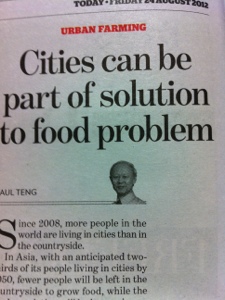
Urban Farming in SG?
Saturday, August 18, 2012
Somewhat Disconnected
In recent months, I have been telling some friends that Singaporeans appear to be oblivious to the ongoing financial and economic crisis that is raging across the globe. I base my claim on the following:
While I'm not sure when reality will reassert itself in the Singaporean consciousness, I'm waiting patiently and collecting data points in the mean time. And one such data point is the following comment by that consummate financial insider, George Soros, made recently to Newsweek:
And to put money where his mouth is, Mr. Soros has reportedly been selling his financial stocks (the growth story) and buying more gold (the-sky-is-falling story).
In the meantime, the bubble continues to expand in Singapore. We live in interesting times indeed!
- Record COE prices
- Property prices that continue to rise despite a decade of inflation at roughly double the rate of wage increases
- New graduates asking for higher pay and quick promotions.
While I'm not sure when reality will reassert itself in the Singaporean consciousness, I'm waiting patiently and collecting data points in the mean time. And one such data point is the following comment by that consummate financial insider, George Soros, made recently to Newsweek:
“I am not here to cheer you up. The situation is about as serious and difficult as I’ve experienced in my career,” Soros tells Newsweek. “We are facing an extremely difficult time, comparable in many ways to the 1930s, the Great Depression. We are facing now a general retrenchment in the developed world, which threatens to put us in a decade of more stagnation, or worse. The best-case scenario is a deflationary environment. The worst-case scenario is a collapse of the financial system.”
And to put money where his mouth is, Mr. Soros has reportedly been selling his financial stocks (the growth story) and buying more gold (the-sky-is-falling story).
In the meantime, the bubble continues to expand in Singapore. We live in interesting times indeed!
Monday, August 6, 2012
Romney's tax returns
The left-wing bias in the social media is quite apparent, judging from the endless stream of posts attacking Mitt Romney for his wealth and his alleged failure to disclose more of his tax returns.
These people conveniently ignore the fact that Geithner is a tax evader who has not been prosecuted.
I don't give two hoots about Romney, but the double standard is somewhat jarring.
These people conveniently ignore the fact that Geithner is a tax evader who has not been prosecuted.
I don't give two hoots about Romney, but the double standard is somewhat jarring.
Sunday, August 5, 2012
Our Instant Noodle Culture
In the online chatter about Feng Tian Wei's Olympic medal, the usual argument that Singapore does not have a culture conducive to sports has again surfaced. The usual suspects have again been trotted out to be 'shot': our education system which only cares for academic success, MINDEF/National Service, parents who value monetary success etc.
To me, this country's lack of success in sports is a symptom of a more deeply-entrenched problem: the desire to achieve success in the shortest possible time.
This not only explains the sports issue, but also why we have failed to achieve anything significant internationally in areas such as science and technology. Look at how many Singaporeans are in graduate programmes in these areas in our local universities?
And is it any wonder that the preferred careers these days all involve finance and banking? Or that we have become a service-based economy, since making things at the international level is too difficult? Or that our students finish school barely literate in their Mother Tongues and can barely string a proper sentence together in standard English?
This culture is also shown in our governmental policies, which often seek to take the easy path to economic growth, avoiding painful choices that will harm powerful vested interests. And it is likely to get worse, as increasing political competition from opposition parties will force the PAP government to adopt populist measures to appease an electorate that is generally ignorant and adolescent in its demands.
This kind of mentality will surely be harmful to the country's development in the long-run. And I think the long-run has arrived.
To me, this country's lack of success in sports is a symptom of a more deeply-entrenched problem: the desire to achieve success in the shortest possible time.
This not only explains the sports issue, but also why we have failed to achieve anything significant internationally in areas such as science and technology. Look at how many Singaporeans are in graduate programmes in these areas in our local universities?
And is it any wonder that the preferred careers these days all involve finance and banking? Or that we have become a service-based economy, since making things at the international level is too difficult? Or that our students finish school barely literate in their Mother Tongues and can barely string a proper sentence together in standard English?
This culture is also shown in our governmental policies, which often seek to take the easy path to economic growth, avoiding painful choices that will harm powerful vested interests. And it is likely to get worse, as increasing political competition from opposition parties will force the PAP government to adopt populist measures to appease an electorate that is generally ignorant and adolescent in its demands.
This kind of mentality will surely be harmful to the country's development in the long-run. And I think the long-run has arrived.
Our Fundamental Vulnerabilities
I had a conversation recently with an old friend over Whatsapp, wherein we discussed issues pertaining to the challenges that Singapore faces. I was surprised when he commented that the country was in general decline. The reason for my surprise was not that I didn't know that the country was in decline, but that I didn't expect it to come from him, given, as it were, that he was knee-deep into the property market, having only recently bought a second property in what I consider a topping market.
Be that as it may, the idea of a coming crisis as a conversational topic is not particularly attractive to most Singaporean at this time, a point which I re-validated last week when a friend of mine who shares many of my views introduced me to another person. After trying for 15 minutes to discuss the fundamental problems facing the country, I found that he was not at all interested, thinking that it was something too remote.
In fact, given that episode last week, I am quite close to giving up altogether trying to get the people I know to think about some of the challenges that I believe will come our way within the next few years. I had also thought about closing down this blog permanently.
So while I ponder about my next steps in this area, let me list down some of the very basic vulnerabilities that we face, as an antidote to the maddeningly irrelevant issue of whether Feng Tian Wei deserves our praise or otherwise.
The list would include:
The above is a short list, but it includes factors upon which the entire edifice of Singaporean life is built.
More on these issues in future, perhaps.
Be that as it may, the idea of a coming crisis as a conversational topic is not particularly attractive to most Singaporean at this time, a point which I re-validated last week when a friend of mine who shares many of my views introduced me to another person. After trying for 15 minutes to discuss the fundamental problems facing the country, I found that he was not at all interested, thinking that it was something too remote.
In fact, given that episode last week, I am quite close to giving up altogether trying to get the people I know to think about some of the challenges that I believe will come our way within the next few years. I had also thought about closing down this blog permanently.
So while I ponder about my next steps in this area, let me list down some of the very basic vulnerabilities that we face, as an antidote to the maddeningly irrelevant issue of whether Feng Tian Wei deserves our praise or otherwise.
The list would include:
- Energy
- Food
- Dependence on foreigners in key areas of the economy
- Dependence on government to take initiative
- Loss of expertise in key technological area, which results in
- Key pieces of national infrastructure being increasingly vulnerable to systemic failure
- Excessive household debt due to overpriced COEs and property
The above is a short list, but it includes factors upon which the entire edifice of Singaporean life is built.
More on these issues in future, perhaps.
Sunday, July 22, 2012
Rising Food Prices
In recent days, corn and wheat prices have hit record levels, based on futures trading data. This is due in large part to drought in the US and heavy rains in the Black Sea region of Russia, which has affected output. Furthermore, while soy beans have not risen as much, it could do so given similar fundamentals.
As such, it would not be surprising if food prices start to rise in the coming months in Singapore, leading to more hardship for us. Riots in the poorer parts of the world may also happen, like 2 years ago. Food security will likely come into public focus once again.
In that regard, the latest government initiative is a plan to import more vegetables from Indonesia. This would not be the first attempt by the Singapore government to diversify our sources of vegetable imports (away from China and Malaysia) by seeking the help of Indonesia. Previous attempts have ended in rather spectacular failure, based on information from some of my contacts. I wonder why MND is leading us down the same wrong path again, given the serious lack of reliability of suppliers from that country.
In my view, time and money would be far better spent investing in the hydroponics ideas of Professor Lee Sing Kong of NIE, who has a feasible plan to make Singapore self-sufficient in leafy vegetables. As much as I am for free-market solutions, the problem is that when it comes to natural resources, countries are becoming increasingly nationalistic. As such, free-market solutions are not the way to go in the foreseeable future. Food security requires non-market solutions. And surely, if it is obvious to me, it ought to be obvious to our very highly-paid, American-educated elite Administrative Service officers.
As such, it would not be surprising if food prices start to rise in the coming months in Singapore, leading to more hardship for us. Riots in the poorer parts of the world may also happen, like 2 years ago. Food security will likely come into public focus once again.
In that regard, the latest government initiative is a plan to import more vegetables from Indonesia. This would not be the first attempt by the Singapore government to diversify our sources of vegetable imports (away from China and Malaysia) by seeking the help of Indonesia. Previous attempts have ended in rather spectacular failure, based on information from some of my contacts. I wonder why MND is leading us down the same wrong path again, given the serious lack of reliability of suppliers from that country.
In my view, time and money would be far better spent investing in the hydroponics ideas of Professor Lee Sing Kong of NIE, who has a feasible plan to make Singapore self-sufficient in leafy vegetables. As much as I am for free-market solutions, the problem is that when it comes to natural resources, countries are becoming increasingly nationalistic. As such, free-market solutions are not the way to go in the foreseeable future. Food security requires non-market solutions. And surely, if it is obvious to me, it ought to be obvious to our very highly-paid, American-educated elite Administrative Service officers.
Sunday, July 15, 2012
Global Slowdown
This week we hear quite a bit of news of global economic weakness. We have various central banks around the world cutting interest rates and taking other easing policy measures in the face of a rapidly weakening global environment.
China's GDP numbers came in weaken than expected while the US earnings season has been kicked off with more warnings of forward weakness.
Back at home, the Singapore economy shrank in the 2nd quarter at an annualized rate of 1.1%, although things appear not to be weak enough given the government's position that emergency measures are not needed as of now.
Despite this, though not unexpectedly, news of. Cut in COE quota has people all agitated about higher prices in the coming months. In fact, there appears to be signs of buyer capitulation, as reported in the news this evening on TV, wherein those who have been holding off buying new cars have decided to go ahead in fear of higher COR prices.
As I have maintained for a long time, that which is unsustainable will break eventually. Thus while the supply of COEs may be falling, I am expecting that demand would also be falling in view of the global economic situation. It is possible that we get a repeat of 2008 in late summer that will lead to a crisis of a more serious nature than the liquidity crisis back then.
Let's see what happens.
China's GDP numbers came in weaken than expected while the US earnings season has been kicked off with more warnings of forward weakness.
Back at home, the Singapore economy shrank in the 2nd quarter at an annualized rate of 1.1%, although things appear not to be weak enough given the government's position that emergency measures are not needed as of now.
Despite this, though not unexpectedly, news of. Cut in COE quota has people all agitated about higher prices in the coming months. In fact, there appears to be signs of buyer capitulation, as reported in the news this evening on TV, wherein those who have been holding off buying new cars have decided to go ahead in fear of higher COR prices.
As I have maintained for a long time, that which is unsustainable will break eventually. Thus while the supply of COEs may be falling, I am expecting that demand would also be falling in view of the global economic situation. It is possible that we get a repeat of 2008 in late summer that will lead to a crisis of a more serious nature than the liquidity crisis back then.
Let's see what happens.
Subscribe to:
Posts (Atom)