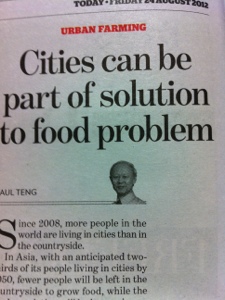
It looks like the idea of urban farming could be going mainstream here in Singapore, if the above story from the Friday edition of TODAY is anything to go by.
Friday, August 24, 2012
Urban Farming in SG?
It looks like the idea of urban farming could be going mainstream here in Singapore, if the above story from the Friday edition of TODAY is anything to go by.
Saturday, August 18, 2012
Somewhat Disconnected
In recent months, I have been telling some friends that Singaporeans appear to be oblivious to the ongoing financial and economic crisis that is raging across the globe. I base my claim on the following:
While I'm not sure when reality will reassert itself in the Singaporean consciousness, I'm waiting patiently and collecting data points in the mean time. And one such data point is the following comment by that consummate financial insider, George Soros, made recently to Newsweek:
And to put money where his mouth is, Mr. Soros has reportedly been selling his financial stocks (the growth story) and buying more gold (the-sky-is-falling story).
In the meantime, the bubble continues to expand in Singapore. We live in interesting times indeed!
- Record COE prices
- Property prices that continue to rise despite a decade of inflation at roughly double the rate of wage increases
- New graduates asking for higher pay and quick promotions.
While I'm not sure when reality will reassert itself in the Singaporean consciousness, I'm waiting patiently and collecting data points in the mean time. And one such data point is the following comment by that consummate financial insider, George Soros, made recently to Newsweek:
“I am not here to cheer you up. The situation is about as serious and difficult as I’ve experienced in my career,” Soros tells Newsweek. “We are facing an extremely difficult time, comparable in many ways to the 1930s, the Great Depression. We are facing now a general retrenchment in the developed world, which threatens to put us in a decade of more stagnation, or worse. The best-case scenario is a deflationary environment. The worst-case scenario is a collapse of the financial system.”
And to put money where his mouth is, Mr. Soros has reportedly been selling his financial stocks (the growth story) and buying more gold (the-sky-is-falling story).
In the meantime, the bubble continues to expand in Singapore. We live in interesting times indeed!
Monday, August 6, 2012
Romney's tax returns
The left-wing bias in the social media is quite apparent, judging from the endless stream of posts attacking Mitt Romney for his wealth and his alleged failure to disclose more of his tax returns.
These people conveniently ignore the fact that Geithner is a tax evader who has not been prosecuted.
I don't give two hoots about Romney, but the double standard is somewhat jarring.
These people conveniently ignore the fact that Geithner is a tax evader who has not been prosecuted.
I don't give two hoots about Romney, but the double standard is somewhat jarring.
Sunday, August 5, 2012
Our Instant Noodle Culture
In the online chatter about Feng Tian Wei's Olympic medal, the usual argument that Singapore does not have a culture conducive to sports has again surfaced. The usual suspects have again been trotted out to be 'shot': our education system which only cares for academic success, MINDEF/National Service, parents who value monetary success etc.
To me, this country's lack of success in sports is a symptom of a more deeply-entrenched problem: the desire to achieve success in the shortest possible time.
This not only explains the sports issue, but also why we have failed to achieve anything significant internationally in areas such as science and technology. Look at how many Singaporeans are in graduate programmes in these areas in our local universities?
And is it any wonder that the preferred careers these days all involve finance and banking? Or that we have become a service-based economy, since making things at the international level is too difficult? Or that our students finish school barely literate in their Mother Tongues and can barely string a proper sentence together in standard English?
This culture is also shown in our governmental policies, which often seek to take the easy path to economic growth, avoiding painful choices that will harm powerful vested interests. And it is likely to get worse, as increasing political competition from opposition parties will force the PAP government to adopt populist measures to appease an electorate that is generally ignorant and adolescent in its demands.
This kind of mentality will surely be harmful to the country's development in the long-run. And I think the long-run has arrived.
To me, this country's lack of success in sports is a symptom of a more deeply-entrenched problem: the desire to achieve success in the shortest possible time.
This not only explains the sports issue, but also why we have failed to achieve anything significant internationally in areas such as science and technology. Look at how many Singaporeans are in graduate programmes in these areas in our local universities?
And is it any wonder that the preferred careers these days all involve finance and banking? Or that we have become a service-based economy, since making things at the international level is too difficult? Or that our students finish school barely literate in their Mother Tongues and can barely string a proper sentence together in standard English?
This culture is also shown in our governmental policies, which often seek to take the easy path to economic growth, avoiding painful choices that will harm powerful vested interests. And it is likely to get worse, as increasing political competition from opposition parties will force the PAP government to adopt populist measures to appease an electorate that is generally ignorant and adolescent in its demands.
This kind of mentality will surely be harmful to the country's development in the long-run. And I think the long-run has arrived.
Our Fundamental Vulnerabilities
I had a conversation recently with an old friend over Whatsapp, wherein we discussed issues pertaining to the challenges that Singapore faces. I was surprised when he commented that the country was in general decline. The reason for my surprise was not that I didn't know that the country was in decline, but that I didn't expect it to come from him, given, as it were, that he was knee-deep into the property market, having only recently bought a second property in what I consider a topping market.
Be that as it may, the idea of a coming crisis as a conversational topic is not particularly attractive to most Singaporean at this time, a point which I re-validated last week when a friend of mine who shares many of my views introduced me to another person. After trying for 15 minutes to discuss the fundamental problems facing the country, I found that he was not at all interested, thinking that it was something too remote.
In fact, given that episode last week, I am quite close to giving up altogether trying to get the people I know to think about some of the challenges that I believe will come our way within the next few years. I had also thought about closing down this blog permanently.
So while I ponder about my next steps in this area, let me list down some of the very basic vulnerabilities that we face, as an antidote to the maddeningly irrelevant issue of whether Feng Tian Wei deserves our praise or otherwise.
The list would include:
The above is a short list, but it includes factors upon which the entire edifice of Singaporean life is built.
More on these issues in future, perhaps.
Be that as it may, the idea of a coming crisis as a conversational topic is not particularly attractive to most Singaporean at this time, a point which I re-validated last week when a friend of mine who shares many of my views introduced me to another person. After trying for 15 minutes to discuss the fundamental problems facing the country, I found that he was not at all interested, thinking that it was something too remote.
In fact, given that episode last week, I am quite close to giving up altogether trying to get the people I know to think about some of the challenges that I believe will come our way within the next few years. I had also thought about closing down this blog permanently.
So while I ponder about my next steps in this area, let me list down some of the very basic vulnerabilities that we face, as an antidote to the maddeningly irrelevant issue of whether Feng Tian Wei deserves our praise or otherwise.
The list would include:
- Energy
- Food
- Dependence on foreigners in key areas of the economy
- Dependence on government to take initiative
- Loss of expertise in key technological area, which results in
- Key pieces of national infrastructure being increasingly vulnerable to systemic failure
- Excessive household debt due to overpriced COEs and property
The above is a short list, but it includes factors upon which the entire edifice of Singaporean life is built.
More on these issues in future, perhaps.
Sunday, July 22, 2012
Rising Food Prices
In recent days, corn and wheat prices have hit record levels, based on futures trading data. This is due in large part to drought in the US and heavy rains in the Black Sea region of Russia, which has affected output. Furthermore, while soy beans have not risen as much, it could do so given similar fundamentals.
As such, it would not be surprising if food prices start to rise in the coming months in Singapore, leading to more hardship for us. Riots in the poorer parts of the world may also happen, like 2 years ago. Food security will likely come into public focus once again.
In that regard, the latest government initiative is a plan to import more vegetables from Indonesia. This would not be the first attempt by the Singapore government to diversify our sources of vegetable imports (away from China and Malaysia) by seeking the help of Indonesia. Previous attempts have ended in rather spectacular failure, based on information from some of my contacts. I wonder why MND is leading us down the same wrong path again, given the serious lack of reliability of suppliers from that country.
In my view, time and money would be far better spent investing in the hydroponics ideas of Professor Lee Sing Kong of NIE, who has a feasible plan to make Singapore self-sufficient in leafy vegetables. As much as I am for free-market solutions, the problem is that when it comes to natural resources, countries are becoming increasingly nationalistic. As such, free-market solutions are not the way to go in the foreseeable future. Food security requires non-market solutions. And surely, if it is obvious to me, it ought to be obvious to our very highly-paid, American-educated elite Administrative Service officers.
As such, it would not be surprising if food prices start to rise in the coming months in Singapore, leading to more hardship for us. Riots in the poorer parts of the world may also happen, like 2 years ago. Food security will likely come into public focus once again.
In that regard, the latest government initiative is a plan to import more vegetables from Indonesia. This would not be the first attempt by the Singapore government to diversify our sources of vegetable imports (away from China and Malaysia) by seeking the help of Indonesia. Previous attempts have ended in rather spectacular failure, based on information from some of my contacts. I wonder why MND is leading us down the same wrong path again, given the serious lack of reliability of suppliers from that country.
In my view, time and money would be far better spent investing in the hydroponics ideas of Professor Lee Sing Kong of NIE, who has a feasible plan to make Singapore self-sufficient in leafy vegetables. As much as I am for free-market solutions, the problem is that when it comes to natural resources, countries are becoming increasingly nationalistic. As such, free-market solutions are not the way to go in the foreseeable future. Food security requires non-market solutions. And surely, if it is obvious to me, it ought to be obvious to our very highly-paid, American-educated elite Administrative Service officers.
Sunday, July 15, 2012
Global Slowdown
This week we hear quite a bit of news of global economic weakness. We have various central banks around the world cutting interest rates and taking other easing policy measures in the face of a rapidly weakening global environment.
China's GDP numbers came in weaken than expected while the US earnings season has been kicked off with more warnings of forward weakness.
Back at home, the Singapore economy shrank in the 2nd quarter at an annualized rate of 1.1%, although things appear not to be weak enough given the government's position that emergency measures are not needed as of now.
Despite this, though not unexpectedly, news of. Cut in COE quota has people all agitated about higher prices in the coming months. In fact, there appears to be signs of buyer capitulation, as reported in the news this evening on TV, wherein those who have been holding off buying new cars have decided to go ahead in fear of higher COR prices.
As I have maintained for a long time, that which is unsustainable will break eventually. Thus while the supply of COEs may be falling, I am expecting that demand would also be falling in view of the global economic situation. It is possible that we get a repeat of 2008 in late summer that will lead to a crisis of a more serious nature than the liquidity crisis back then.
Let's see what happens.
China's GDP numbers came in weaken than expected while the US earnings season has been kicked off with more warnings of forward weakness.
Back at home, the Singapore economy shrank in the 2nd quarter at an annualized rate of 1.1%, although things appear not to be weak enough given the government's position that emergency measures are not needed as of now.
Despite this, though not unexpectedly, news of. Cut in COE quota has people all agitated about higher prices in the coming months. In fact, there appears to be signs of buyer capitulation, as reported in the news this evening on TV, wherein those who have been holding off buying new cars have decided to go ahead in fear of higher COR prices.
As I have maintained for a long time, that which is unsustainable will break eventually. Thus while the supply of COEs may be falling, I am expecting that demand would also be falling in view of the global economic situation. It is possible that we get a repeat of 2008 in late summer that will lead to a crisis of a more serious nature than the liquidity crisis back then.
Let's see what happens.
Subscribe to:
Posts (Atom)