Thursday, November 29, 2012

SMRT strike - NSP's shameless political opportunism

The National Solidarity Party issued a statement on Nov 28 regarding the illegal strike.  While paying lip service to the rule of law, much of the statement appeared to be an attempt to throw stones at SMRT management and to try to justify the actions taken by the errant bus drivers.

Painting the issue as a 'breakdown in our labour relations' shows the narrowness of the thinking of the NSP leadership in trying to blame the PAP establishment for the problem (a usual opposition tactic, I might add). As I was advised by a Singaporean who is an experienced China hand, the issue was in large part due to cultural differences between Singapore's style of running things and the mindset of the PRC workers.  Would that really qualify as a 'breakdown in our labour relations'?  While I can understand the need for Singapore companies to adapt to foreign practices when operating overseas, the case of the Singapore management bending backwards on a core principle like the freedom to set wages locally is much weaker.  Why should a local company operating within Singapore adopt the standard PRC practice of '同工同酬‘, especially since there are valid HR reasons for paying Malaysian workers more?

Besides this, there is also evidence to suggest that the PRC drivers did not attempt to engage SMRT management regarding their issues, as can be see from a news report carried by Yahoo! Singapore:
One Malaysian bus driver who spoke to Yahoo! Singapore was visibly annoyed at Monday's strike, saying the move to do so was "irresponsible and uncalled for".

"First of all, they should have approached the management first to discuss things," he said. "Going on strike is illegal and we all understand that."

So, was there really a 'breakdown in our labour relations'?

The more disturbing thing about the NSP statement is that by citing allegations by poor pay and living conditions, the party appears to be trying to use 'moral' arguments to justify the breaking of the law.  Aside from the fact that this is factually incorrect, since the unhappiness was about alleged unequal treatment relative to Malaysian drivers, the NSP has failed to realise that such arguments open up a can of worms, since 'moral' grounds are ill-defined and everyone can then argue that they have valid reasons for breaking the law.  Where do we then draw the line so that we can unequivocally condemn those who break the law?

Of course, I'd expect that the NSP cite the first paragraph of its statement to show that it respects the rule of law. But as far as I am concerned, its statement on the matter shows the typical politician's 'gift' of talking out of both sides of one's mouth.

And if I may add, the NSP seems to be a shadow of its old self since the departure of Goh Meng Seng.

Friday, September 21, 2012

Double Standards Regarding Religious Sensitivities

Google has decided to block Singapore IPs from using Youtube to view a film that Muslims deem to be offensive to their religion.  This is well and good, since it is arguably consistent with Singapore laws on religious harmony.

At the same time, I noticed that no liberal Singaporeans has complained of Google's move as being a fetter on the freedom of speech.  In stark contrast, when Christians complained to the government about The Da Vinci Code being blasphemous and offensive to them, the same liberals were quick to condemn the complaints as attempts to restrict freedom of speech.  So, prima facie, it would appear that these people think that the religious sensitivities of Christians do not deserve to be respected.

A standard argument put forth was that The Da Vinci Code was not really offensive, and that Christians who complained were too sensitive and ought not feel offended.  But that's a silly argument, since sensitivities are subjective, and depends on the feelings of those who are at the receiving end of the 'treatment'.  Those not at the receiving end have no valid grounds to judge whether anything is offensive or otherwise.  After all, it can easily be argued that white European skin-heads would not consider the film about Islam to be offensive and that Muslims have been too sensitive and ought not feel offended as well.

I hope you see my point, which is that if we want to promote free speech, the same standards should apply to all, or if we are in favour of curtailing free speech with an eye towards respecting religious sensitivities, such curtailment should also be applied consistently.

Wednesday, September 12, 2012

On that National Conversation

Since the PM's National Day Rally speech, the country has been abuzz with talk about the national conversation. We got all sorts of voices clamouring for attention, and as expected, complaints from certain opposition parties about being excluded.

While I expect many issues to be discussed, I suspect that what I consider the really important issues facing the country will be left undisturbed.  Based on the noises so far, all the talk about an inclusive society and so forth centres around the issue of social welfare, with many Singaporeans asking for assistance and handouts of one form or another from the government.  While these issues are important, they are secondary, in my view.

What I think ought to be discussed, but won't will include things like the fundamental vulnerabilities facing the country, like the lack of food and energy security, as well as geopolitical issues like the South China Sea disputes.  To me, given the current and expected future global environment of the next 10-20 years, there will be a lot of external forces that will serious rock Singapore's 'boat', whether we like it or not.  The best thing to do is to have everyone understand these issues and prepare for them.  Unfortunately, the exercise will likely turn out to be like a squabble over who gets to eat more of the buffet while the ship is heading into stormy seas.

I am of the view that we need desperately to address the fundamental issues, as they will affect how Singaporeans see our own future prospects, and in turn, our willingness not to commit collective suicide by refusing to reproduce ourselves.

More on these in a future post.

Friday, August 24, 2012

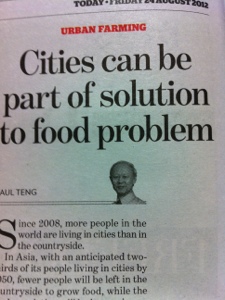
Urban Farming in SG?


20120824-080725.jpg

It looks like the idea of urban farming could be going mainstream here in Singapore, if the above story from the Friday edition of TODAY is anything to go by.

Saturday, August 18, 2012

Somewhat Disconnected

In recent months, I have been telling some friends that Singaporeans appear to be oblivious to the ongoing financial and economic crisis that is raging across the globe.  I base my claim on the following:

  • Record COE prices

  • Property prices that continue to rise despite a decade of inflation at roughly double the rate of wage increases

  • New graduates asking for higher pay and quick promotions.


While I'm not sure when reality will reassert itself in the Singaporean consciousness, I'm waiting patiently and collecting data points in the mean time.  And one such data point is the following comment by that consummate financial insider, George Soros, made recently to Newsweek:
“I am not here to cheer you up. The situation is about as serious and difficult as I’ve experienced in my career,” Soros tells Newsweek. “We are facing an extremely difficult time, comparable in many ways to the 1930s, the Great Depression. We are facing now a general retrenchment in the developed world, which threatens to put us in a decade of more stagnation, or worse. The best-case scenario is a deflationary environment. The worst-case scenario is a collapse of the financial system.”

And to put money where his mouth is, Mr. Soros has reportedly been selling his financial stocks (the growth story) and buying more gold (the-sky-is-falling story).

In the meantime, the bubble continues to expand in Singapore.  We live in interesting times indeed!

Monday, August 6, 2012

Romney's tax returns

The left-wing bias in the social media is quite apparent, judging from the endless stream of posts attacking Mitt Romney for his wealth and his alleged failure to disclose more of his tax returns.

These people conveniently ignore the fact that Geithner is a tax evader who has not been prosecuted.

I don't give two hoots about Romney, but the double standard is somewhat jarring.

Sunday, August 5, 2012

Our Instant Noodle Culture

In the online chatter about Feng Tian Wei's Olympic medal, the usual argument that Singapore does not have a culture conducive to sports has again surfaced.  The usual suspects have again been trotted out to be 'shot': our education system which only cares for academic success, MINDEF/National Service, parents who value monetary success etc.

To me, this country's lack of success in sports is a symptom of a more deeply-entrenched problem: the desire to achieve success in the shortest possible time.

This not only explains the sports issue, but also why we have failed to achieve anything significant internationally in areas such as science and technology.  Look at how many Singaporeans are in graduate programmes in these areas in our local universities?

And is it any wonder that the preferred careers these days all involve finance and banking? Or that we have become a service-based economy, since making things at the international level is too difficult? Or that our students finish school barely literate in their Mother Tongues and can barely string a proper sentence together in standard English?

This culture is also shown in our governmental policies, which often seek to take the easy path to economic growth, avoiding painful choices that will harm powerful vested interests.  And it is likely to get worse, as increasing political competition from opposition parties will force the PAP government to adopt populist measures to appease an electorate that is generally ignorant and adolescent in its demands.

This kind of mentality will surely be harmful to the country's development in the long-run.  And I think the long-run has arrived.