Showing posts with label food prices. Show all posts

Tuesday, May 17, 2011

Michael Snyder: A Food Crisis is Looming

Many Singaporeans have been complaining about rising food prices in the past 2 years and many have put the blame on the government. As is typically Singaporean, we prefer to look for someone else to blame rather than recognise the fact that irrespective of blame, the most urgent thing to do is the protect ourselves and our families by taking steps to ameliorate the effects of more expensive food.

For those who feel that something is not quite right but need a little bit of extra push to get going in terms of preparedness, here's a recent article on the possible global food crisis that we may soon have to face:

In case you haven’t noticed, the world is on the verge of a horrific global food crisis. At some point, this crisis will affect you and your family. It may not be today, and it may not be tomorrow, but it is going to happen. Crazy weather and horrifying natural disasters have played havoc with agricultural production in many areas of the globe over the past couple of years. Meanwhile, the price of oil has begun to skyrocket. The entire global economy is predicated on the ability to use massive amounts of inexpensive oil to cheaply produce food and other goods and transport them over vast distances. Without cheap oil the whole game changes. Topsoil is being depleted at a staggering rate and key aquifers all over the world are being drained at an alarming pace. Global food prices are already at an all-time high and they continue to move up aggressively. So what is going to happen to our world when hundreds of millions more people cannot afford to feed themselves?


The full article can be found here: 20 Signs That a Global Food Crisis is Coming.


Saturday, April 2, 2011

Inflation Thoughts 20110402

2 issues: Strength of SGD and food inflation

First off, CNA has reported that SM Goh, who is also chairman of MAS, has expressed the view that while a stronger SGD will help to mitigate inflation, he is also wary about allowing it to appreciate by too much. This is the conundrum that the MAS has to face given the reckless money printing of global central banks.

On the one hand, the SGD exchange rate is a convenient tool for managing inflation, given that we are so dependent on imports. On the other hand, too high an exchange rate relative to our Asian neighbours would mean that Singapore exporters become less competitive. Furthermore, given our dependence on tourists from the region, it would also make Singapore a more expensive destination.

To a certain extent, our exchange rate policy is not totally free from the monetary policies of other Asian countries such as China, Japan and South Korea, given the need to maintain competitiveness. As such, my view is that unless China decides to stop clowning around with price controls and get serious about fighting its inflation problem through both credit tightening and the appreciation of the RMB, there is a limit to how far the SGD can be allowed to strengthen without hurting the economy.

Given the limits of the extent to which the SGD exchange rate can be used as an inflation-fighting tool, the government will need to implement policies that deal with some of the high-cost structures within the local economy, especially with respect to land and rental prices.

Food Inflation
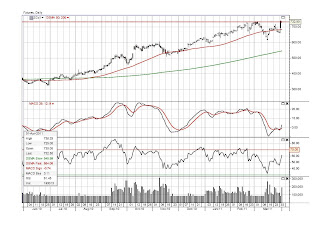

Given how much the price of corn has risen recently, an agricultural investment analyst has noted that the price of meat will have to increase by around 50% in USD terms over the next few years for farmers to maintain their profit margins. Corn is a major animal feed in the production of beef and pork, amongst other things. Becoming a vegetarian looks increasingly attractive from a cost perspective.

As for wheat, this year's crop could be adversely affected by the worst drought in Texas in over 40 years. With the availability of wheat exports from Russia still uncertain and increasing imports by China, wheat prices could also continue to firm up.

More directly for Singaporeans, Thailand has raised the possibility of limiting its exports in order to keep prices low at home, as part of their security policy of keeping the poor people from rioting like those in Africa and the Middle East. This may mean higher rice prices in the coming months. Time to increase one's long-term storage of rice perhaps?


Short of a reversal in the money printing policy or the advent of Round 2 of the 2008 global financial crisis (which I believe is inevitable, only a matter of timing), we can expect more inflation ahead, regardless of what the government tries to do.

Saturday, March 26, 2011

Inflation - We Must Protect Ourselves

 Based on the feedback that I see on both the REACH and CPF Facebook pages, many Singaporeans are still whining about inadequate government action with respect to dealing with the inflation problem.  For those who are still labouring under the delusion that the government will be able to help them with this bread-and-butter issue, I offer up the latest piece of evidence that such hopes are woefully misplaced:
 
Upgrading key to tackling inflation

In this CNA news report, MND Minister Mah Bow Tan was quoted as saying:
Oil prices are shooting up and food prices are going up, so how do we lower the price of food when we have to pay more to import food? The only way is to upgrade our skills and increase our pay.
A major reason for rising oil and food prices is simply the non-stop money printing engaged by all the major central banks around the world, including those of China and India besides those of the Western powers and Japan.  Skills upgrading doesn't solve the problem at all.  This is very simple monetary theory.

When I see such a lack of understanding of basic economics from a Cabinet minister, I tell myself that I need to deal with the problem on my own, and not expect the government to be able to help me.

And no, I'm not going to get started on how current policies make the 'upgrade your skills so that you can increase your pay' logic flawed and misleading.  That's for another day.

Saturday, March 19, 2011

IMF: Rising Food Prices May Be Here to Stay

The IMF has warned again that rising food prices may not be a temporary phenomenon.  In an article in the Finance and Development magazine, it has noted that food prices are now close to the highs of 2008.  A summary of the article can be found here.

Unfortunately, the IMF has only attributed the problem to poor harvests, the use of biofuels and higher energy prices. It has ignored the fact that aggressive money printing by the advanced economies have also contributed a large part to the problem.

Friday, February 11, 2011

On the Egyptian Situation

Based on the headlines that I have seen on my Facebook news feed, posted by politically liberal people on my friends list, the mainstream media appears to be making the demonstrations against President Mubarak as a struggle for freedom against dictatorship and tyranny.  Yet, as with all things regarding the Middle East, it's never as simple as the liberal press would like to us to believe.  Lurking behind the scenes could well be forces that are advancing a dialectical process that progressives in the press are so familiar with, a process that they have deceptively coat with a veneer of morality (good vs evil) in order to hide the truth.

For those who think that Mubarak is a hideous dictator oppressing a freedom-loving people, one may want to consider the following passage from this source:
Nine out of ten Egyptian women suffer genital mutilation. US President Barack Obama said Jan. 29, “The right to peaceful assembly and association, the right to free speech, and the ability to determine their own destiny … are human rights. And the United States will stand up for them everywhere.” Does Obama think that genital mutilation is a human rights violation? To expect Egypt to leap from the intimate violence of traditional society to the full rights of a modern democracy seems whimsical.
In fact, the vast majority of Egyptians has practiced civil disobedience against the Mubarak regime for years. The Mubarak government announced a “complete” ban on genital mutilation in 2007, the second time it has done so - without success, for the Egyptian population ignored the enlightened pronouncements of its government. Do Western liberals cheer at this quiet revolt against Mubarak’s authority? 
[...] In the most fundamental matters, President and Mrs Mubarak are incomparably more enlightened than the Egyptian public. Three-quarters of acts of genital mutilation in Egypt are executed by physicians.
What does that say about the character of the country’s middle class?
And while the mainstream media has portrayed the demonstrations as a manifestation of the people's frustrations with many issues including rising food prices, it's not hard to observe that the poor people who are really hurt by such things are not the ones demonstrating, but rather the educated middle-class people.  So again one has to ask whether there are forces behind the scenes trying to manipulate the situation to their advantage.  This perspective was considered by the private intelligence service STRATFOR.

In one of their Intelligence Guidance notes, the following was written:
What we have to find out is who is behind this. It could be the military wanting to stage a coup to keep Gamal Mubarak out of power. They would be doing this to preserve the regime, not to overthrow it. They could be using the demonstrations to push their demands and perhaps pressure Hosni Mubarak to leave voluntarily.
The danger is that they would be playing with fire. The demonstrations open the door for the Muslim Brotherhood, which is stronger than others may believe. They might keep the demonstrations going after Hosni leaves, and radicalize the streets to force regime change. It could also be the Muslim Brotherhood organizing quietly. Whoever it is, they are lying low, trying to make themselves look weaker than they are — while letting the liberals undermine the regime, generate anti-Mubarak feeling in the West, and pave the way for whatever it is they are planning.
I don't have any particular views about the situation in Egypt.  Just like the folks at STRATFOR, I am more interested in finding out whether there are larger forces lurking behind the scenes that may have more global impact.

Thursday, February 10, 2011

SGD Exchange Rate and Inflation

On 1 Feb, the Standard Chartered Bank's Global Research team published a report on inflation entitled Inflation: illusionary, imflammatory.  On page 4 of the report was a table (Table 1) showing CPI inflation data of various countries in Asia.  Part of that table is reproduced below:


2008 HighHeadlineCoreNon-CoreFood/Energy Weight
China8.74.62.68.30.44
Hong Kong6.33.11.95.30.29
Singapore7.54.62.110.00.41


From the above data, we can see that despite its hard USD peg which does not allow its currency to gradually appreciate in order to slow down imported price pressures, Hong Kong has achieved the lowest rates of inflation.

Looking at the Non-Core portion of the inflation data, which includes food and energy prices, the difference between Hong Kong and Singapore is even more remarkable.  Both territories import almost all of their food and energy, so in theory, an appreciating currency ought to ameliorate some of the effects of higher import prices.  Hong Kong imports most of its food from China, whose currency has actually appreciated relative to the USD and HKD, which adds to the cost pressures in the former.  And yet, it has a lower food/energy inflation rate than Singapore.


So unfortunately for us here in Singapore, the much steeper appreciation of the SGD does not appear to have helped as far as food inflation is concerned.

(As an aside, since the trade-weighted index used by the MAS is not public information, I chose to use the USD exchange rate as what I believe to be a reasonable proxy for the strength of the SGD, given that a very significant part of our trade appears to be denominated in USD.)

So it leads me to wonder whether there are domestic factors that have acted to negate the positive impact of an appreciating SGD on the inflation rate.  I have no answers, but it's something to think about, isn't it?

Tuesday, February 8, 2011

Video: US Fed QE and Food Inflation

A short but comprehensive explanation by Bill Fleckenstein on how the reckless money printing by the US Federal Reserve is causing food inflation and hurting the poorest people in the world.

Friday, February 4, 2011

Earth to Bernanke

With many Americans concerned about the rising costs of food and other necessities, Bernanke's latest speech at the National Press Club indicated that he doesn't think inflation is a serious problem in the US. I wonder if he lives on another planet.

In any event, his stance on inflation produced an immediate reaction in the commodities market, as we can see from the 5-min gold futures chart below:
As mentioned previously, I was too risk-averse to make long bets on commodities at this stage, and Bernanke proved me wrong. The rough rice futures contract moved higher again and it was a mistake on my part not to have taken a position.

Thursday, February 3, 2011

Food Crisis 2011 - Will Politics Trump Markets?

While we in Singapore complain about the high price of barbeque pork slices, a favourite Chinese New Year food, high food prices have had far less sanguine effects on the poorer parts of the world, as we have seen from the political turmoil in Tunisia, Egypt and the rest of that region of the world. Wheat prices have hit a 30-month high and have doubled since a low in mid-2010, and this has obviously had a negative impact on Egypt, who has to import around half of its annual consumption.

With developing countries close to screaming in pain from the inflation exported by the United States through Bernanke's disastrous quantitative easing policy, I have to wonder how much more food prices have to go up before Hillary Clinton tells Bernanke and the President's Working Group on Financial Markets (the so-called 'Plunge Protection Team') to step in and cool things down.

As an aside, I tend to think that Obama is a mere teleprompter-reading puppet who has neither the intelligence nor experience to deal with such complex issues, and that Mrs. Clinton is the real brains behind such matters. Being a Marxist agitator ('community organiser') in the Saul Alinsky tradition in Chicago is not a real job.

Such an intervention in the commodities market is not without precedent. It had happened before in 2008 during what Donald Coxe, chairman of Coxe Advisors LLC, called the 'Saturday Night Massacre', where it was thought that the US government, working through its Wall Street connections, hammered down commodity prices through the futures market. The only difference between now and 2008 was that the US political class had a vested interest in having commodity prices down due to the then-impending Presidential Elections. As for the present situation, I would argue that being the sole (albeit declining) superpower in the world, the US has a vested interest in trying to keep things under control, especially when it comes to the Middle East, where it is engaged in protracted wars in Iraq and Afghanistan that it has no hope of winning. Allowing things to further deteriorate will definitely have a negative impact on the global economy, on the stability of the Middle East and possibly on the supply and price of oil.

Be that as it may, looking at the various charts of agricultural commodities, rice has just broke its sideways pattern to move up to a 27-month high while wheat and corn may still have further upside. That said, I am wary of getting into long positions, as my sense of the consensus view is that too many people think prices will keep going up due to supply challenges underpinning the fundamental picture of food commodities. The fundamentals are correct, but with the CCI breaking record after record on the upside, I am just worried that the opinions are too one-sided and that there is a speculative frenzy feedback loop fed by the ongoing social unrest. Since I am somewhat a kiasu person, I am most likely going to sit out this episode of price movements.

And given that rice prices have start to move, we need to be on a lookout for protests and social unrest in those parts of the world where rice is the major staple food. So far, our region has been spared unrest, but don't count on that to continue if rice prices start to move aggressively up like wheat and corn.

In the meantime, I'll be thankful for the abundant food available here in Singapore and enjoy my Chinese New Year.

Tuesday, January 25, 2011

Food inflation and Price Caps

Someone, in a letter to the Today newspaper published on Monday, suggested that the government implement measures to cap price increases in essential food items to fight what he perceives to be profiteering. The example of Malaysia was used by the author to justify the feasibility of price controls.

That the idea is unsound is very obvious when one considers the following points:
  • Malaysia has significant domestic food production capabilities, and doesn't have to be a price-taker on the international food market.
  • It has an elaborate government bureaucracy designed to subsidise various parts of the food production value-chain so as to keep prices low.
  • Capping food prices in Singapore's context will mean a fall in supply if the caps make selling some items unprofitable for importers.
  • Price caps benefit both the rich and poor, so that if subsidies were involved, it would be an inefficient use of taxpayers' money.
I think the government's approach of targeted help for the lower income group is a better method as it does not create as much distortions in the food market and help is only given to people who need it. For the rest of us in the middle class, we can adjust to higher food prices by cutting back on other discretionary spending.

That said, the government can help to some extent by using its influence on NTUC Fairprice to have the latter introduce more price competition in the food market, so as to minimise the risk of profiteering. Using competition to fight profiteering is far better than using legal sanctions, as anyone who understands elementary economics will know.

Tuesday, January 11, 2011

Up Next: More Food Inflation

It's now official: the government expects more food inflation this year. According to a Bloomberg report, Finance Minister Tharman Shanmugaratnam told Parliament that the government expects food prices to rise further this year and that there are efforts to look at how to cushion the lower-income and elderly people from such inflation.

Apart from the traditional transfer payments, it would be of great interest to me to see what other innovative ideas the government can come up with to ameliorate the effects of food inflation. For the rest of the people who are in the so-called 'middle-class' and are unlikely to be the target of any such government measures, it's time to take defensive actions such as the adjustment of eating and purchasing habits, or even of growing vegetables where feasible.

Friday, January 7, 2011

Food Crisis 2011 - Riots in Algeria

The Associated Press has reported that youth in Algeria had rioted on Thurs over rising food prices and high unemployment. This could be the first salvo in what may become a global food crisis in 2011 as developing countries cope with food inflation brought about, in my view, by the reckless money printing of various countries trying to devalue their respective currencies in order to export their way out of economic troubles. Chief amongst these is of course the US Federal Reserve and the People's Bank of China.

In India, food inflation for Dec 2010 was over 18% in a situation that is worsening, contrary to the expectations of government officials there.

In Singapore, the situation is also getting worse. Someone who runs a food stall at the canteen in my office building told me over lunch that food inflation is serious enough to have an impact on the stall's selection of food inputs and the type of dishes that can be sold profitably.

We need to get prepared. Remember to stock up on essential food items when there are cheap sales.

Saturday, January 1, 2011

My Outlook for 2011

After an eventful 2010, I believe that 2011 will bring even more surprises as we move into the next phase of the global financial crisis. Here are some of my thoughts on what could be important issues for the year:

Sovereign Debt Crisis

With credit spreads of the PIIGS countries near record levels, I believe that the market will start to recognise that the debt problems of the EU countries cannot be resolved without either outright default or being inflated away through debt monetisation. I also believe that the US and China's debt problems will start to appear on the radar screens of more investors, and that there is a small chance of them being blown up to full-scale crises. All these will make investing very 'interesting' in 2011, to put things mildly.

Singapore General Elections

While I am not able to foresee whether there will be significant changes to Parliament following the next GE, I believe that none of the long-term problems facing our country will be tackled irrespective of the GE results. As I have previously mentioned, I don't believe that any of the opposition parties have any clue about the serious external threats that Singaporeans will have to deal with in the next decade. As for the PAP government, since I am not privy to what goes on inside the system, I can only say that the outward signs are that no one there appears to be willing to discuss the same long-term threats as well. As such, as far as I can tell, the next GE will not have any direct bearing on those long-term issues.

Retirement

Singaporeans will continue to ignore the looming retirement crisis by over-spending on real estate and cars, while at the same time complaining about the high cost-of-living in the country. We will raise concerns about foreigners taking away our jobs but at the same time fail to realise that this heightened job insecurity situation is at odds with our willingness to commit to 35-year housing loans in order to have the old stereotypical 'good life' of living in a private apartment. Those under 40 will continue to display an ignorance of the virtues of thrift. Many will seek to maintain their standard of living by spending their parents' wealth, thus endangering the retirement savings of the latter. The harsh reality of diminished future prospects due to greater global competition will continue to be ignored.

Inflation

Short of a wholesale deleveraging like what we saw in 2008, where investors sold every kind of risk assets, there is a good chance that oil and food prices will continue to move higher given the supply and demand fundamentals of these markets. Furthermore, if China continues to refuse to let the RMB appreciate against the USD, MAS could be forced to continue letting our money supply grow at high single-digit rates as the US Federal Reserve continue its money-printing and debt monetisation schemes (a.k.a. 'quantitative easing'). This will contribute to higher inflation rates and perhaps inflation in some local asset markets. Singaporeans will complain about the inflation but will do nothing to deal with the issue, preferring to blame the government and ignoring the power of our own behavioural choices.

Self-reliance

PM Lee's New Year's Day message contained a call to 'strengthen the spirit of self-reliance among Singaporeans'. I believe Singaporeans will continue to bitch and moan against the government whenever we are unhappy with things, and prefer to see ourselves as victims rather than do the adult thing of taking responsibility. And because of this, very few people will be interested in preparedness.

Have a joyous and peaceful 2011!

Saturday, December 18, 2010

Fighting inflation

This week, Channel NewsAsia reported that the price of a cup of coffee is expected to increase soon due to the rising cost of coffee beans. Having argued that inflation is heading higher for several years now, this has not been a surprise to me. What caught my attention in the CNA report was this quote:

Coffee drinkers appeared resigned to paying more for their daily cuppa. Insurance agent Dennis Lim might switch from drinking premium coffee at high-end joints to cheaper alternatives if prices go up steeply. "We don't have much choice. We need drinks to go with our food when eating out," said the 40-year-old.

To me, such an attitude is too passive to have in the face of rising inflation. To fight inflation, we need to send signals to the market that there is a limit to our tolerance for higher prices. And we do that by adapting our behaviour as prices rise. For example, using the above case of buying drinks, I know of very well-to-do people who bring a water bottle out during lunch, because they refuse to pay inflated drink prices at coffee-shops.

By adjusting our spending patterns, we can signal to retailers our limits. In turn, this will eventually allow landlords to get the message that they can't keep raising rents. We should start voting with our wallets and stop acting like sheep.

Sunday, November 21, 2010

Possible Food Crisis in 2011 - UN

The UN's Food and Agriculture ItalicOrganisation's latest Food Outlook has reported that there could be a global food crisis next year, and asked that the world be prepared for greater price volatility.

According to the report:

  • World cereal production will contract by 2% instead of the 1.2% expansion in an earlier forecast.
  • Inventory in world cereal is expected to drop by 7%. Barley will decline by 35%, corn by 12% and wheat by 10%
  • Only rice stockpiles are expected to increase, by about 6%.
  • Prices of some food types may rise up to 2008 levels.

If the FAO report is accurate, it will mean food riots next year as had happened in 2008. I think for the problem to be fixed at least partially, we have to stop the idiocy of biofuels, especially palm and corn-based fuels. It's ridiculous to devote so much land and resources to produce motor fuel when people run the risk of starvation.

For us here in Singapore, it is perhaps time again to look into preparing for this possible crisis by means of food storage and some limited forms of urban agriculture. Preparing early could mean saving some money if food inflation should become a serious issue. In China, it already is. So we need to be watchful.

Monday, November 1, 2010

More Bad News on Inflation

With bakeries in Singapore reportedly raising prices for their products due to the sharp rise in the price of sugar, there is now more bad news as Bloomberg reports that cooking oils are poised to see price increases as record demand has brought inventories down to 17-year lows.

"Inventories of soybean oil and palm oil, used by Nestle SA and Unilever and in everything from Hellmann’s mayonnaise to Snickers candy bars, will drop 12 percent in the coming year as China and India increase consumption 11 percent, U.S. Department of Agriculture data show. Food prices climbed in September to the highest level since the crisis in 2008 that sparked riots from Haiti to Egypt, the United Nations says."

Indeed, China and India will be the prime drivers of demand for agricultural commodities for years to come.

Monday, October 18, 2010

Food Inflation at McDonald's

Here's an example of subtle food inflation. While McDonald's has managed to keep the stick prices of its value-meals from rising too quickly, a check at the quality and quantity of its food shows that food inflation shows up in the form of lower quality.


The Big Mac's beef patty looks a fair bit smaller than it used to.


And it's dry, even though the photo was taken immediately after the burger was sent to my table.

Wednesday, October 13, 2010

Quantitative Easing and Rising Food Prices

In my last post, I wrote about the effects of global monetary stimulus on stock prices. Along the same lines of argument, it can also be argued that in addition to poor harvests, rising food prices can also be partly attributed to the pools of liquidity sloshing around the globe looking for higher returns. And in fact, a hedge fund manager has made this particular argument, as seen in the blog article enclosed below:


From an end-user perspective, it of course sucks that food prices are going higher, irrespective of the causes. But what we can't change, we adapt to by taking defensive measures such as food storage, eating out less etc.

Sunday, October 10, 2010

Are we near a food crisis?

The Financial Times has reported on worries of an impending food crisis after the U.S. Department of Agriculture predicted that the country’s stocks of corn would halve to their lowest levels in 14 years.

Looking at the price increases, there seems to be cause for concern indeed. Data shows that in USD terms, year-on-year prices have increased as follows:

  • Beef - 23%
  • Pork - 68%
  • Sugar - 24%
  • Coffee - 45%
  • Barley - 32%
  • Oranges - 35%
Given that money in the bank is earning almost 0% interest, it does appear to me that 'investing' in a store of food at home is likely more profitable, given the rates of food price inflation.

Saturday, October 2, 2010

Another Peak Oil Report from the U.S. Military

After the United States Joint Forces Command published its Joint Operating Environment 2010 report in February this year in which the issue of peak oil was mentioned, the US military has one again dealt with the issue in a new report entitled Fueling the Future Force: Preparing the Department of Defense for a Post-Petroleum Environment.

While the report has made some unrealistic assessments about biofuels, it does make an important point, namely that we are currently in a period of relatively cheap oil prices and living under the misconception that there are ample supplies, resulting in prices not reflecting the true value of oil and a lack of incentives to move away from this source of energy. This sentiment is similar to the one expressed by the late Matthew Simmons, who said that oil was too precious to be burnt away in cars as transportation fuel.

The point regarding the lack of incentives is particularly pertinent to Singapore, as one of the reasons for the slow pace of deploying solar energy systems is that they are not economical at current oil and natural gas prices. Whether or not we will be able to make the transition in time towards using more solar energy systems in the future when oil prices are sufficiently high is at present a matter of speculation. That said, from an energy security perspective, it would appear to me to be prudent to start working on the transition now even when it does not make short-term economic sense, since we do not know when supplies will become unavailable even if we are willing to pay the higher prices that will definitely be demanded for the remaining precious supply of oil.